
You have a high-stakes conversation or a crucial discovery call in ten minutes. Your heart rate is climbing, your palms are sweaty, and you’re mentally cycling through a script you don’t feel ready to talk through. We’ve all been there, and many employees are likely living that stress daily.
When employees don’t get to practice important work conversations enough in advance, the business pays the price. They’re nervous at best, and unprepared or unconvincing at worst.
Many organizations rely on one-on-one shadowing or static slide decks to train their teams, assuming if a person understands the theory, they can handle the execution. But the consequences can be costly. When your team hasn’t practiced, their chances of success plummet.
Let’s use sales as an example. Without practice, sellers are effectively using your highest-value prospects as guinea pigs for their pitches. And without proper preparation, these opportunities could be wasted. Research shows that 80% of sales reps fail to reach their full potential due to a lack of proper coaching.
But it isn’t just sales. Managers who haven’t rehearsed or experienced difficult conversations often avoid them entirely, leading to unresolved conflict and cultural impacts.
Without a structured way to simulate these moments, your team is practicing in the moments that matter most, and that’s a risky way to learn.
The Power of Rehearsal in Business
In the theater, a cast never goes from a first table-read straight to opening night. There is a vital middle ground: rehearsal. A lot of rehearsal. This is a safe, controlled environment where actors can miss a cue, try a different emotional tone, or stumble over their delivery. All so they can exceed audience expectations on the night of the real production.
Yet, in modern business, that transition is often skipped. Organizations ask their teams to read a script (a slide deck or handbook) and then immediately perform on the main stage (a high-stakes client meeting or difficult management conversation). With enough motivation, employees may practice alone, but that still means they never get feedback. There’s no sounding board to help them course-correct. And if they practice with a colleague or leader to get that feedback? It takes time and is, sometimes, just as nerve-wracking as the “real” presentation.
Why Add AI Roleplay Coaching Into Corporate Training?
Roleplay is the corporate version of the dress rehearsal. It shifts the learning model from passive reading to active performance. Employees transform from „I read the script“ performers into „I’ve handled this a dozen times“ professionals. Here’s why that shift to immersive learning matters:
1. Building „Muscle Memory“ for the Brain
Research in neuroplasticity suggests that the brain doesn’t distinguish significantly between a vivid simulation and a real event. By practicing a pitch or a negotiation, employees are building neural pathways (muscle memory) that allow them to stay calm and articulate when the pressure is actually on.
2. Enabling an Immediate Feedback Loop
Practice without feedback can reinforce bad habits. By providing instant, objective critiques, roleplays allow learners to course-correct immediately rather than after an unsuccessful meeting.
3. Establishing Psychological Safety to „Fail Forward“
When an employee practices with a manager or a peer, there is often a fear of judgment that hinders true learning. AI-driven roleplays remove that social anxiety. Learners are free to try different strategies, stumble over their words, and fail without consequences. This psychological safety is the secret sauce to innovation and rapid skill acquisition.
AI Roleplay Tools at Work: Launching a New Product
Imagine your business just launched a revolutionary product targeting a different Ideal Customer Profile (ICP) than the one your team is used to. Your seasoned sales reps are experts at qualifying old leads, but they are struggling to speak the language of this new buyer.
This is where Degreed Maestro roleplays prime them for this change.
The Employee Perspective
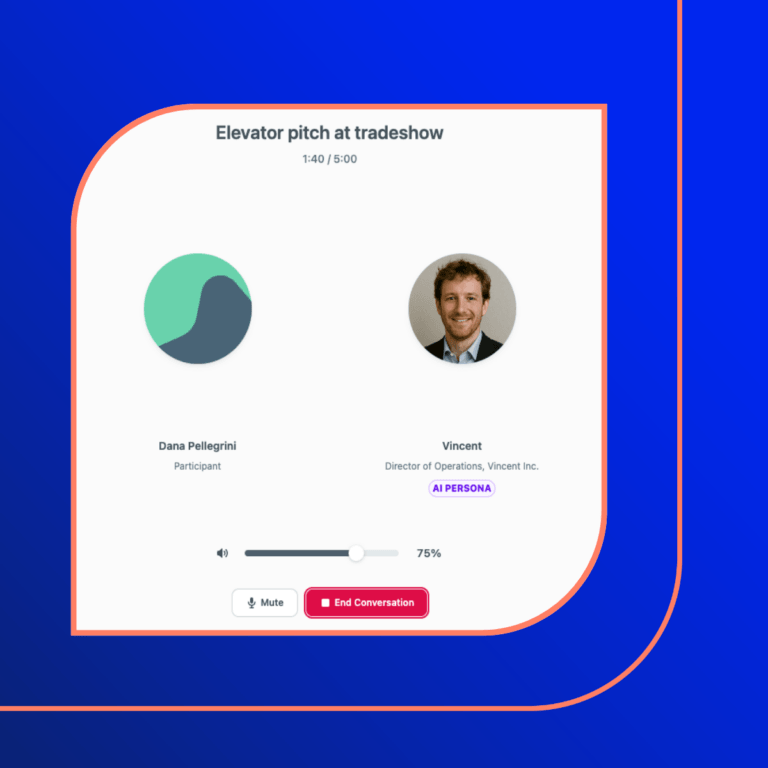
Sarah has a discovery call with a prospect for the new product in 10 minutes. She’s nervous because she knows her old discovery questions won’t work anymore. She jumps into Maestro for a 5-minute roleplay. Maestro roleplays allow her to practice a presentation or conversation with an AI persona and receive feedback after. In this case, she is tasked with delivering an elevator pitch to a persona that is customized to match the new ICP. After a quick session with this custom AI persona, Maestro delivers a scorecard with information like:
- Identifying Stakeholders: 5/5
- Uncovering Decision-Making Process: 4/5
- Identifying Pain Points: 2/5
Sarah received a low score on pain points along with a personalized recommendation for improvement. Maestro tells her: „You’re asking about budget too early. Try asking how the current manual process affects their team’s weekly output to uncover the real pain.“ Sarah reads the feedback, adjusts her strategy, and walks into her real meeting feeling prepared, not panicked.
The Admin Experience: Data-Driven Coaching
While Sarah is practicing, Admins can add guardrails, create custom roleplays, and see skill-building reports to track progress and identify gaps. They are able to:
- Build the Scenario: Add specific context about the new product and ICP.
- Define Excellence: Set custom rubrics with clear instructions on what a high-scoring answer looks like.
- Identify Trends: Review aggregated reports and notice trends. For example, maybe the whole team is crushing stakeholder identification, but 70% are struggling with the new „pain point“ criteria on the scorecard. Instead of guessing what training is needed, the Admin immediately shares a targeted resource guide on „Pain Point Discovery for the New ICP“ with the whole team.
Exploring More Use Cases
While discovery calls are a classic use case, the need for practice spans every department. In a time of organizational transformation, high-stakes conversations are the gears that keep business running. Consider:
- Performance Reviews: Helping managers deliver tough feedback with empathy
- Candidate Interviewing: Ensuring a consistent and unbiased hiring process
- Conflict Resolution: Navigating internal friction before it impacts culture
- Mentoring & Coaching: Empowering leaders to guide their teams effectively
Real-World Impact: TEKsystems
This isn’t just theory. Global industry leaders are already seeing the results.
TEKsystems utilized dynamic AI roleplays to provide a „gym“ for new sellers to practice foundational skills like elevator pitches and objection handling. By entrusting basic skill repetition to AI, the organization redirected high-cost leadership time toward strategic deal coaching. As a result, 25% of the sellers using Maestro successfully moved into the solutioning phase of their first deal within six months. This result represents a significant acceleration of the sales learning cycle, as previously, it took new sellers 36 – 40 months to reach that same milestone. That’s getting a first meeting 6x faster.
Build Organizational Confidence, One Practice Session at a Time
Transformation and capability building happens through practice.
At the end of the day, every business is built on conversations. Whether it’s a big pitch or a small check-in, we all want to feel prepared and heard. But reading about it isn’t the same as doing it.
Maestro Roleplays are designed to offer a safe, private space to build confidence and skills. With tailored context to fit the needs of your team and your business, Roleplays help give employees the confidence to walk into any conversation feeling prepared, and give your leaders the data-driven insights they need to coach with precision.
Want to see how to get started? Explore Maestro Roleplays
Unser heißer Draht zu Ihnen.
Exklusive Einblicke, Infos zu bevorstehenden Veranstaltungen, Updates zu Degreed-Lösungen – das alles erwartet Sie in unserem monatlichen Newsletter.