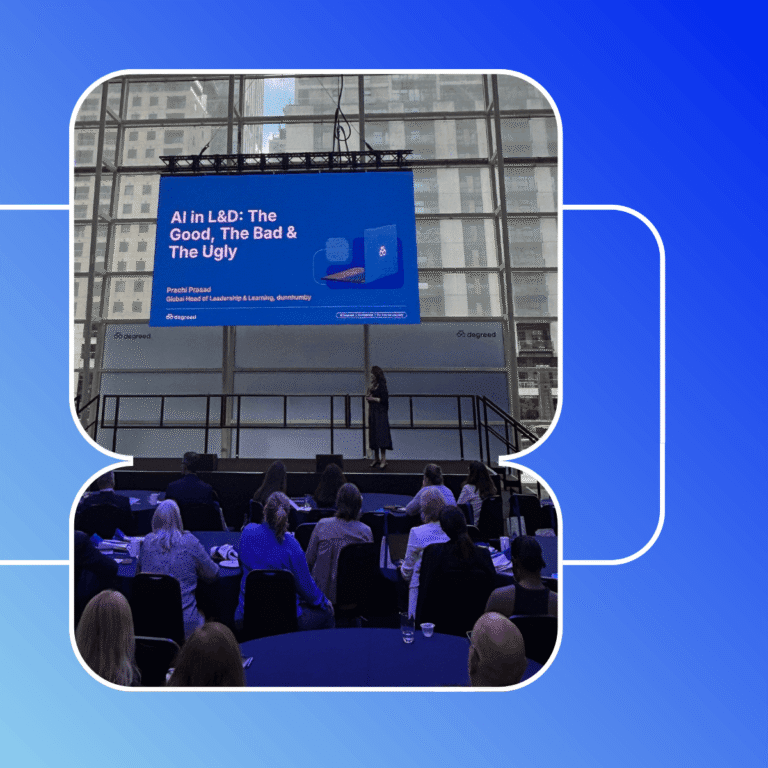

The solution to your AI adoption challenges might not be another AI tool. It might be a coach. One that may not even be human.
“We can’t mandate self-directed learning,” said Prachi Prasad, Global Head – Leadership and Learning Development at dunnhumby. “So we’ve got to create the conditions and the ecosystem for it.”
That’s the working hypothesis at dunnhumby, a global customer data science company powering household-name brands like Tesco, Walmart, and Nestlé.
Coaching was central to that ecosystem. But delivering it consistently to 3,000 employees across 25 countries wasn’t a scale human coaches alone could cover.
« Self-direction does sound very empowering, but it’s empowerment without support,” said Prasad. “It does feel like solitude at times. So coaching was something we looked at where we thought, ‘We can scale this problem […]. We just can’t deliver consistent quality by humans alone. The math just doesn’t work.’ »
That’s when dunnhumby turned to AI-powered coaching to supplement its skill development. The team tried everything: off-the shelf tools, a bespoke internal build, and a purpose-built solution. Prasad walked Degreed event attendees through three AI coaching experiments the team has been running to close the gap between the technology employees have and the capability to use it.
Play 1: Off-the-Shelf AI Coaching
The first experiment was a simple, off-the-shelf AI coaching tool that lets employees record themselves doing a pitch, practicing a presentation, or navigating a difficult conversation. The AI coach analyzes pace and content, offers feedback, and asks probing questions.
Initial results were promising. dunnhumby launched it to its technology and data science team, who valued the ability to practice without human judgment. NPS was high and the response was overwhelmingly positive. Performance improvement was even noticeable during client pitches.
The problem was the interface. It was inconsistent in delivering meaningful and applicable feedback. The product offered little room to configure or improve it. So, the dunnhumby team made the call to move on.
Result: The AI coach worked, but the interface didn’t. It was well-liked, but did not consistently produce the needed value.
Play 2: In-House, Bespoke AI Coaching
The second play was the DIY approach. dunnhumby built its own AI coaching tool called « Change the Conversation. » The coach was grounded in the organization’s proprietary 4D framework and deployed directly in Microsoft Teams.
Practice scenarios could be entirely custom, and employees trusted it because it was built on dunnhumby’s own context and framework. Engagement was real. NPS exceeded 60.
But the cost of building from scratch was significant and maintaining a bespoke tool required ongoing attention and investment.
« It takes investment both in terms of time and dollars, » Prasad noted.
The learning curve for both creation and maintenance was steep. When you build from scratch, you take on responsibility for everything that supports it, including the organizational readiness to use it.
Result: The custom built model was highly trusted, often used. Also costly to build and expensive to maintain.
Play 3: Career Development AI Coaching on Degreed Maestro
The third play is still in progress, but so far according to Prasad, “It’s closest to what we are trying to get to in terms of looking at how or what people become.”
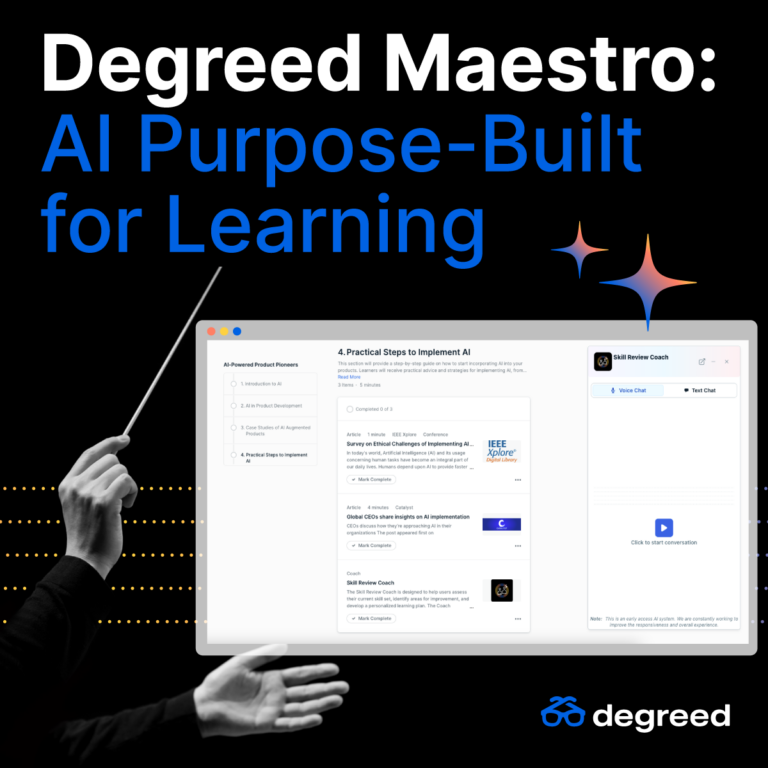
This play is a career development coach on Degreed Maestro. Unlike a general-purpose AI-driven tool, Maestro knew dunnhumby. The capability framework, career development resources, the 70:20:10 methodology, and learning data employees already have on Degreed were all loaded in. The context was there.
Employees can use this career development coach to identify skill gaps, build action plans, and prepare for conversations with their managers, on their own schedule. With the roll out, coaching became available whenever needed, anywhere and at any time.
« It’s not about taking the human out of those development conversations, but at 11 p.m. when you’re having career anxiety, you know you have someone that you can go to, » said Prasad.
Result: Still in progress, but the combination of on-demand access and deep organizational context is already producing a more seamless development experience.
Experimenting With the AI Coaching Use Case
According to Prasad, “Am I starting with the right use case?” is the first question to ask. No matter what technology you try, if you don’t start with the right use case, you won’t see the right results. After that, Prasad recommends asking:
- Is the workflow clear enough for AI?
- What role should AI actually play?
- What systems does it need to connect with?
- What is the governance and control layer?
- How will we know it’s working?
For dunnhumby, coaching was the answer to a self-directed learning problem the team couldn’t scale through content alone. Its three experiments worked out a more specific question: Which tools could deliver coaching at scale, on demand, and with enough organizational context to be useful?
That’s an AI experiment with an actionable outcome.
Sharing what didn’t work is as valuable as sharing what did. The organizations building real AI capability aren’t picking the shiniest tool. Or the easiest one. They’re pressure-testing until they find the right one. That’s what dunnhumby did.

Restons en contact
Je souhaite m’inscrire à la newsletter mensuelle pour me tenir informé(e) des prochains événements, bénéficier d’éclairages exclusifs et recevoir l’actualité des solutions Degreed.