
“Why aren’t people using the new AI tools we paid for?”
Executives deserve to know why a new change or upskilling initiative they invested in, like AI adoption, isn’t sticking. You have numbers: an adoption dashboard, completion rates, and usage stats, but you’re missing the why.
Learning, HR, and talent leaders should expect this question more, not less, as AI tools relentlessly reshape work and change gets more perpetual.
According to Gartner, only 28% of AI use cases fully succeed and meet ROI expectations. PwC’s 2026 Global CEO Survey found the same pattern across more than 4,400 CEOs: only 30% reported increased revenue from AI in the last 12 months.
Yet, investments in AI continue to grow while adoption and results stay flat. If that sounds familiar, you’re not alone and what you’re really missing is the why.
Adoption data shows you something isn’t working. It doesn’t tell you where it’s breaking down, which employees are struggling, or what would actually fix it.
Closing that gap requires a different kind of data. You need to capture and measure what employees are actually experiencing: their confidence, their specific concerns, and the friction points that never surface in a completion report.
Recalibrating Data-Driven Decision-Making
Most leaders facing stalled adoption aren’t flying blind. They’re making decisions. But informed by what?
- Some respond to the employees who openly offer their feedback—the “loudest” voices.
- Some draw on past experiences.
- Some go off a gut read from a town hall or a handful of manager conversations.
- Some look at the adoption data and extrapolate from there.
All of those are reasonable. They’re also all incomplete. None tell you what most employees experience. What about the ones who finished the training but still won’t use the tools? Or the ones sitting on specific concerns that never made it into a survey or a one-on-one?
There’s a whole other data set leaders are missing that will tell them exactly that.
Introducing Guided Conversations
Guided Conversations is a Degreed capability that’s built to surface and measure what other data can’t: the why behind the numbers.
Guided Conversations lives within Degreed Maestro and lets you hear from your entire workforce. Maestro conducts structured, AI-powered conversations with employees, asking the questions you’d want a good manager to ask your entire organization.
You get org-wide insight into what’s landing, what isn’t, and where to intervene, without waiting for manager escalations or bringing in expensive outside consultants.
From the employee’s side, it’s a simple conversation with AI. No forms, no limiting answer scales. Because it’s not a manager and it’s still a casual conversation, employees tend to be more candid. And because insights are aggregated and anonymized, there’s no social risk. You hear from everyone, including the people who would never raise their hand in a town hall.
Example: Guided Conversations Insights In Action
Here’s what it looks like to use Guided Conversations in practice for AI fluency and adoption:
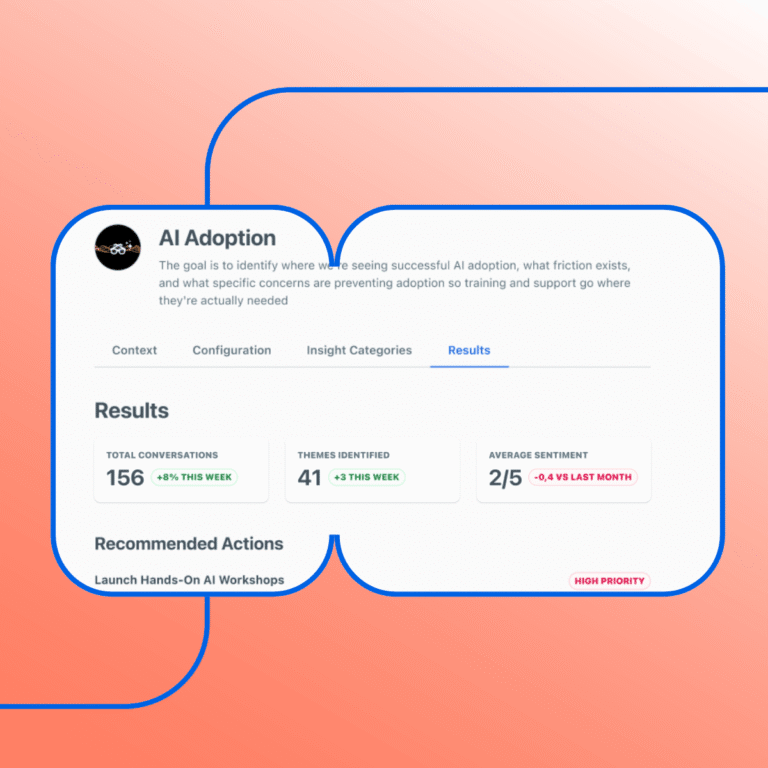
Let’s say that your digital adoption data for a new tool is low. You set up an AI adoption Guided Conversation to find out more. Here’s what comes back:
→ 156 employees complete the conversation.
→ Average sentiment comes back at 2/5.
→ A need for additional training is the most common theme, surfacing in 65 conversations and trending up.
→ Data privacy concerns run close behind, with 27 conversations surfacing some version of “I don’t know what I’m allowed to put into these tools,” concentrated heavily among individual contributors.
→ Prompt engineering and AI governance are flagged as high-priority development areas.
You discover that most employees aren’t refusing to use AI; they’re stuck on specific, fixable things, and the conversations tell you what. Employees don’t know where to start or how to get useful outputs from the tools they’ve been given.
The segment data tells you where to focus first. In this case, individual contributors represent 56% of responses and carry the lowest sentiment at 2.8/5. Their top concern is data privacy, which means a clear policy and FAQ will move the needle quickly.
From that picture, the Guided Conversations system surfaces a set of prioritized recommended actions:
- Launch hands-on AI workshops targeting individual contributors and team leads first, where training gaps are highest and sentiment is lowest. From the Guided Conversations results page, you can generate a learning blueprint directly.*
- Publish AI data-use guidelines to address the privacy concerns blocking adoption by individual contributors.
- Define department-specific use cases for employees who are open to AI but don’t yet see how it applies to their work.
Each to-do is specific, prioritized, and grounded in the conversations with employees. It doesn’t just surface the “why.” It tells you what you can do about it, so you can remove blockers and increase AI fluency as quickly as possible.
Making Guided Conversations a Critical Change Management Tactic
AI adoption is one use case, but finding out why any key business transformation stalls is essential for pushing forward. The same approach works anywhere you’re navigating change and need to identify quickly what’s working, what’s blocking progress, and where to focus for the highest impact, including:
- Leadership transformation: Where are new managers struggling with their direct reports before it becomes a retention issue? Are leaders feeling confident, or quietly overwhelmed?
- New sales methodology rollout: Is the new framework landing? Which parts are unclear, and which teams are hesitant to implement it?
- Org-wide Restructuring: When roles and reporting lines shift, where is the confusion concentrated? Who is most at risk of disengaging?
- Onboarding: Are new hires getting what they need, or are there friction points in the first 90 days that nobody is surfacing until someone quits?
Guided Conversations surfaces what completion data can’t: the specific insight that tells you where to act and the recommended next steps.
Embracing Conversations That Tackle Change
The leaders who can answer what’s driving adoption and what’s blocking it, where friction is concentrated and why, at any point in a change initiative, are the ones moving their programs forward. Guided Conversations is built to give you the answers with quantitative insight at scale, organized into actionable themes and recommended next steps.
The next time someone asks why leaders question a stalled change initiative, you’ll have the answer and solution.
*coming soon


Let’s keep in touch.
Sign me up for the monthly newsletter with exclusive insights, upcoming events, and updates on Degreed solutions.