How Pernod Ricard Turned Skill Development Into a Business Strategy
For years, learning lived in the background, separate from top-line business strategy. Then, with the...
By building a skills-first ecosystem with Degreed, Pernod Ricard unified learning across 18,000 global employees, saved €600K, and put workforce skills intelligence in the hands of business leaders.
Summary
Pernod Ricard is one of the world’s leading premium spirits companies, with its 150+ brands, including Jameson, Chivas, Ballantine’s, and Absolut. The company operates in a fast-changing market where consumer expectations, regulatory environments, and supply chain demands are in constant flux. The team faced intense pressure to build the right workforce capabilities, quickly and at scale.
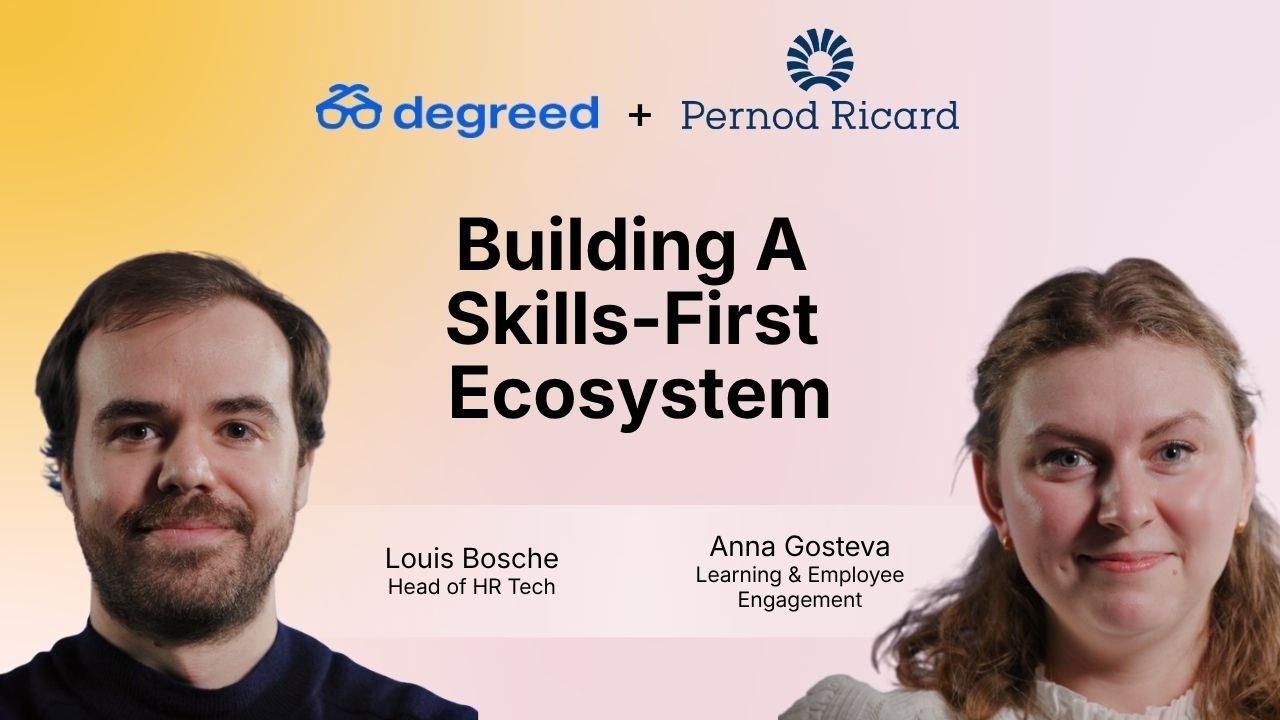
Yet, their learning ecosystem (and skill data) were disconnected, making it impossible to get a complete view of the workforce’s capabilities. To fix this fragmented system, Pernod Ricard partnered with Degreed to build a unified learning hub that ties skills directly to learning and connects to Workday as its source of truth. The result so far has been €600,000 in cost savings from platform consolidation, more than 92% of pilot users returning to the platform more than twice per month, and workforce skill data that the company’s CIO and CHRO are already eager to use to make strategic talent decisions.
Watch the interview: https://www.youtube.com/watch?v=d9WX3spSUXA
COMPANY SNAPSHOT
Industry:
Spirits & Beverages
Headquarters:
Paris, France
Company Size:
~18,000 employees across 70 countries
For Pernod Ricard, workforce transformation had become essential. With consumer expectations changing rapidly, sales and marketing had to adjust just as quickly. Economic and regulatory pressures reshaped global operations. Supply chain resilience and cost efficiency was suddenly a business-critical priority.
The ability to compete in that landscape depended directly on having the right employee capabilities in the right places.
“Our business is changing and it’s changing all the time. We need to bring change to our employees fast. We need to understand where they stand and what maturity they have to bring them towards the future.”
— Louis Bosche, Head of HR Tech, Pernod Ricard
Employees were eager to grow the skills they needed to keep up with market demands. When surveyed, 95% of Pernod Ricard employees said they would stay longer at a company that invested in their professional development. Pernod Ricard’s workforce (and leadership) wanted more clear and effective development opportunities.
Pernod Ricard employees had access to a number of learning experiences, but the learning ecosystem had grown organically over years and accumulated redundant platforms, disconnected tools, and an architecture that the team couldn’t navigate easily. The L&D and leadership teams had no way to track skill progression or spot workforce development gaps that could slow company transformation.
In 2023, Pernod Ricard implemented a skills catalog in Workday tied to approximately 900 job profiles with roughly 20 skills mapped per role. Employees could declare skills and receive basic recommendations, but there was no proficiency scale, no visibility into progression, and no link established between individual skill development and the organization’s needs overall.
Ultimately, Pernod Ricard needed to create a technical architecture that maximized their tech ecosystem and employee development opportunities, while unifying learning experiences and skill data.
To help them build the technical ecosystem and architecture they needed, Pernod Ricard sought a skills-first platform that was natively integrated with Workday, their Human Resources Information System (HRIS).
The tight native integration between Degreed and Workday was a non-negotiable requirement. For Pernod Ricard, Workday is the single source of truth for all employee data, job architecture, and skill taxonomy. The Degreed-Workday bidirectional integration means that when an employee demonstrates skill proficiency, that data updates in real time across both systems and becomes available for talent decisions throughout the organization.
“I’m not sure if there is any other platform in the market today that is as tightly integrated with Workday. This is especially super important for us.”
— Louis Bosche, Head of HR Tech, Pernod Ricard
For them, Degreed offered a single platform where employees can access learning directly connected to their skills profile and receive recommendations tailored to their current proficiency to help achieve their next level—all while pulling in Workday employee data, job architecture, and skill taxonomies. Because skill data flows bidirectionally in real time, the Pernod Ricard team gained access to a comprehensive, actionable picture of workforce skills and learning experience.
“Degreed became our one-stop shop to deliver that experience for employees—a place where they have everything linked to their skills and they’re performing and talking the same language as they have in Workday.”
— Anna Gosteva, Product Owner, Learning & Employee Engagement, Pernod Ricard
By decommissioning duplicate local platforms and centralizing in Degreed, the team eliminated the technical complexity slowing down the process and saved big in a moment when cost efficiency was essential. They can now see all content globally in one place and make informed decisions.
With a new tech ecosystem in place, the team achieved a clear picture of workforce capabilities that allowed them to move toward a skills-based approach.
They established a universal language for skills and rallied the team around five universal, core skills that mapped directly to directly to Pernod Ricard’s corporate strategy:
The Pernod Ricard team made a deliberate decision that helped build trust and drive adoption at scale: Skill data would be used for development and opportunity, but never for performance evaluations or compensation decisions. That single choice increased participation across the organization, including historically harder-to-reach operational populations.
“We can use the skilling initiative as fuel for business growth. We started to think about how, through our upskilling initiative, we can drive business transformation and reach our business objectives.”
— Anna Gosteva, Product Owner, Learning & Employee Engagement, Pernod Ricard
At the same time, Pernod Ricard committed to a minimum one hour of learning per week for every employee, and embedded it into governance standards. This is twice the industry benchmark.
The team is also planning to integrate Degreed Maestro’s AI-powered learning, roleplay, and coaching experience into functional and leadership academies. AI-driven simulations and roleplays will let employees practice skills in context, accelerating the path from “knowing” to “doing.”
Pernod Ricard saved €600,000 by consolidating redundant learning platforms into Degreed. The team is delivering more learning experiences, data insights, and capability intelligence to the business at significantly lower cost.
The pilot launched in February 2026 across select countries with 4,500 employees. Within weeks, the platform had hit its first 1,000 active users, with early participants self-rating, providing an average of eight skills per person. That was a signal that the experience was simple, meaningful, and was earning employee trust.
Currently, 92% of users are returning to the platform at least twice per month. More than 70% of employees across the entire organization have already declared 15 or more skills in Workday, including populations that had historically been difficult to engage.
But the most significant shift isn’t in learning engagement. It’s in how the business uses what Degreed generates. Skills intelligence—including proficiency levels, capability gaps, skill progression by geography and function—is moving out of the L&D dashboard and into the hands of functional leaders. The C-Suite is already seeing the value of the data.
“Our CIO, our CHRO, and all business leaders are asking us: When can I access skill data for my employees? Can I know who has what skills, where, what the proficiency is, and what the gaps are? Because they know that these would be super interesting insights to understand.”
— Louis Bosche, Head of HR Tech, Pernod Ricard